

EPJ D Highlight - Bound and virtual states in low-energy electron and positron scattering
- Details
- Published on 27 June 2025
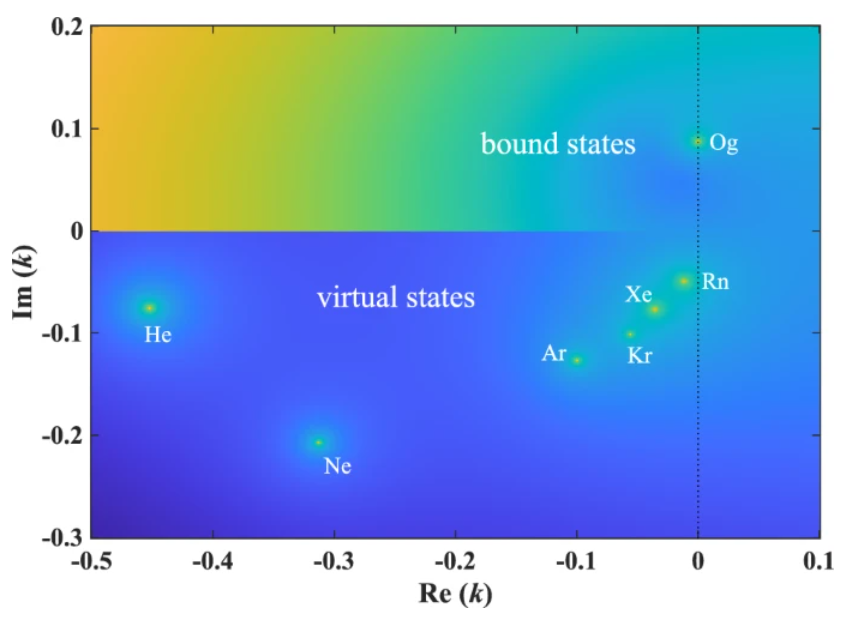
New mathematical approach confirms that low-energy charged particles can briefly bind to atoms or molecules
So far, it has remained an open question whether moving charged particles can briefly form bound states with neutral atoms and molecules. In previous experiments, researchers observed enhanced positron annihilation at energies corresponding to specific vibrational modes in neutral molecules, which they interpreted as evidence that the positrons were briefly bound. Until now, however, this interpretation has not yet been corroborated through other scattering observables.
Through new research published in EPJ D, Kamil Fedus and Grzegorz Karwasz at Nicolaus Copernicus University, Poland, present a new method for estimating the energies of both bound and virtual states of low-energy charged particles from elastic scattering cross-sections. Their approach confirms previous theoretical predictions about the formation of bound and virtual states during the scattering of these particles—helping physicists better understand how the scattering process unfolds.
EPJ D: Holger Kersten appointed Editor-in-Chief
- Details
- Published on 04 April 2025

The European Physical Journal D (EPJ D) is glad to announce that Prof. Holger Kersten (Kiel University, Germany) has been appointed as one of the Editors-in-Chief for the journal starting on January 1st, 2025.
Prof. Kersten’s experience and standing in the field will be invaluable to lead and develop the journal together with the other two Editors-in-Chief Prof. Almut Beige and Prof. Sylwia Ptasinska.
The publishers - EDP Sciences, Springer Nature, and the Italian Physical Society - wish to thank Prof. Joachim Burgdörfer for the great work and effort he demonstrated in leading the journal over the past years.
EPJ D Topical Issue - Electron and positron interactions and their applications: a tribute to Professor Michael Brunger
- Details
- Published on 21 March 2025

Guest editors: Márcio Henrique Franco Bettega, Stephen Buckman, Dragana Maric, Sylwia Ptasinska, Ron White
The Topical issue "Electron and Positron Interactions and Their Applications" is a collection of 27 scientific contributions that honor the exceptional scientific career of our colleague, friend, and collaborator the late Professor Michael James Brunger. The contributions that have been published in this volume are related to the recent state-of-art experimental and theoretical developments and applications in the field of Atomic and Molecular Physics, which include electron, positron, positronium, and photon interactions with atoms, molecules, and crystals. This topical issue received contributions from more than eighty authors and co-authors from sixteen different countries and/or affiliated institutions. Professor Michael J. Brunger was co-author in two of these contributions. Processes such as elastic and electronic inelastic collisions, ionization, and dissociative electron attachment were investigated by different experiments and theoretical methods covering applications in biology, plasma physics, and atmospheric science.
All articles are available here and are freely accessible until 18 May 2025. For further information read the Editorial.
EPJ D Topical Issue - Atomic Spectra and Oscillator Strengths (ASOS14)
- Details
- Published on 27 January 2025

Guest Editors: Paul Indelicato, Stefan Schippers, Alexander Kramida, Glenn Wahlgren, Lydia Tchang-Brillet
The Topical Issue (TI), “Atomic spectra and oscillator strengths”, summarises the basic and primary atomic data needed in modelling a large variety of plasmas, covering radiative properties of atoms and atomic ions in different wavelength ranges going from X-ray to infrared (IR). These data find important applications in solar or stellar atmospheres and other astrophysical plasmas, and also in laboratory plasmas, such as fusion plasmas and laser-produced plasmas, among others.
EPJ D Highlight - Discovering new details in atomic hyperfine structures
- Details
- Published on 20 September 2024

A new approach to analysing infrared spectra reveal 20 new energy levels in the hyperfine structure of Protactinium
Since the late 1960s, the Laboratoire Aimé Cotton (LAC) in Orsay, France, has made significant progress in the classification of complex atomic spectra. These advances have been driven both by the development of Fourier transform spectroscopy, and through novel theoretical interpretations of atomic spectra.
In new research published in EPJ D, Sophie Kröger from the Berlin University of Technology and Economics carried out detailed analysis of Protactinium's infrared (IR) spectrum, revealing 20 new energy levels that were previously undetectable with earlier methods employed by the LAC. The study showcases important progress in the precision of atomic spectrum measurements, which could soon offer deeper insights into atomic structures and interactions.
EPJ D Highlight - Improving tuneability in optical differentiation
- Details
- Published on 23 August 2024

By considering waves which propagate through sample surfaces as light interacts with them, a new technique could make it easier for researchers to create real-time images of microscopic samples.
Optical differentiation is a useful technique for analysing images of microscopic samples in real time. Currently, however, it lacks the ability to fine-tune the resolution in the images it produces.
Through new research published in EPJ D, a team led by Jian Wu at the National University of Defence Technology in Changsha, China, propose a new approach, which enabled them to tune the wavelengths reflected from crystal samples. Their technique could allow researchers to extract far more detailed images of their samples, and would be especially useful for analysing systems of cells and large molecules.
EPJ D Highlight - Investigating the link between N₂O ionization and ozone depletion
- Details
- Published on 02 August 2024

Detailed measurements of the electron-impact ionization cross-section of nitrous oxide shed new light on how Earth’s ozone layer could be depleted by future manmade emissions.
Man-made emissions of nitrous oxide (N2O) are rapidly increasing globally and are predicted to pose a growing threat to Earth’s ozone layer. In the 1970s, it was discovered that N2O in the upper atmosphere can trigger ozone-depleting reactions through its interaction with low-energy electrons. However, the full impact of this process on the ozone layer remains poorly understood.
New research published in EPJ D, led by Mareike Dinger at the national metrology institute of Germany (PTB) in Braunschweig, Germany, provides extensive experimental data on the interaction between N2O and these low-energy electrons. Their measurements could offer deeper insights into the influence of man-made N2O emissions on the future state of Earth’s ozone layer.
EPJ D Highlight - Identifying useful emission lines in the sun’s outer atmosphere
- Details
- Published on 02 August 2024

Experiments reveal deeper insights into the emission lines created by two key ions in the sun’s outer atmosphere
When studying the solar spectrum, researchers often search for specific emission lines: prominent wavelengths emitted by ions as their electrons transition from higher to lower energy levels. Emission spectra of two iron ions, Fe IX and Fe X, are particularly useful for studying the sun’s outer atmosphere. However, both of these spectra contain emission lines that can’t yet be matched with known electron transitions, limiting the information which can be gathered from them.
EPJ D Highlight - Determining Refractive Index at Relativistic Speeds
- Details
- Published on 24 June 2024

Ideas first posed by seventeenth-century physicists have been extended in determining the mechanical refractive index of particles travelling at speeds close to that of light.
If you studied advanced physics at high school, there’s a good chance that you remember Snell’s law, which states how a ray of light bends when it crosses a boundary between two media. According to this law, the ratio of the sines of the incident and refracted angles is a non-universal constant, later understood as the relative refractive index of the refracting medium with respect to the incident one.
EPJ D Highlight - Electron-impact ionization calculations match with experiments
- Details
- Published on 24 June 2024

Through a new calculation approach, researchers have made far more accurate predictions of how atoms are ionized when impacted by high-energy electrons.
During electron-impact ionization (EII), high-energy electrons collide with atoms, knocking away one or more of their outer electrons. To calculate the probability that ionization will occur during these impacts, researchers use a quantity named the ionization ‘cross-section’. EII is among the main processes affecting the balance of charges in hot plasma, but so far, its cross-section has proven incredibly difficult to study through theoretical calculations.
Through new research published in EPJ D, Stefan Schippers and colleagues at Justus-Liebig University of Giessen, Germany, present new calculations for the EII cross-section, which closely match with their experimental results. Their discoveries could provide useful new insights in many fields of research where hot plasma is studied: including astrophysics and controlled nuclear fusion.


